

Clean Suite for CRM: Salesforce FAQs#
General#
What license does Clean Suite need?#
Clean Suite requires a Melissa license key, also called a CustomerID. Enter the key in the Clean Suite administration settings. The key must be active and must include each service that you use.
Express Entry requires an Express Entry entitlement. It consumes credits for requests. A lower minimum-character setting can increase credit use.
Which permissions do users need?#
Assign the Clean Suite permission set that fits the user role. The package includes Melissa_Global_Intelligence_Permission_Set, Melissa_Global_Intelligence_Permission_Set_NonAdmin, and SmartMoverAccess.
Give SmartMover users SmartMoverAccess. Also give users access to the objects and fields that the process reads or updates. Field mappings do not bypass Salesforce field-level security.
For Express Entry, users need access to the required Visualforce pages, Apex class, custom settings, and target fields.
Why does a callout fail?#
First, check that the Melissa license key is valid and entitled for the selected service. Then check the endpoint configuration for that service.
For Express Entry, confirm that the Remote Site Setting for https://expressentry.melissadata.net is active. Also confirm that MDPERSONATOR__MelissaData_ExpressEntry_API and the token named credential in the installed package are active.
After an installation, sandbox refresh, or package migration, check these settings again.
Configuration and Support Path#
Use this path when a service callout fails.
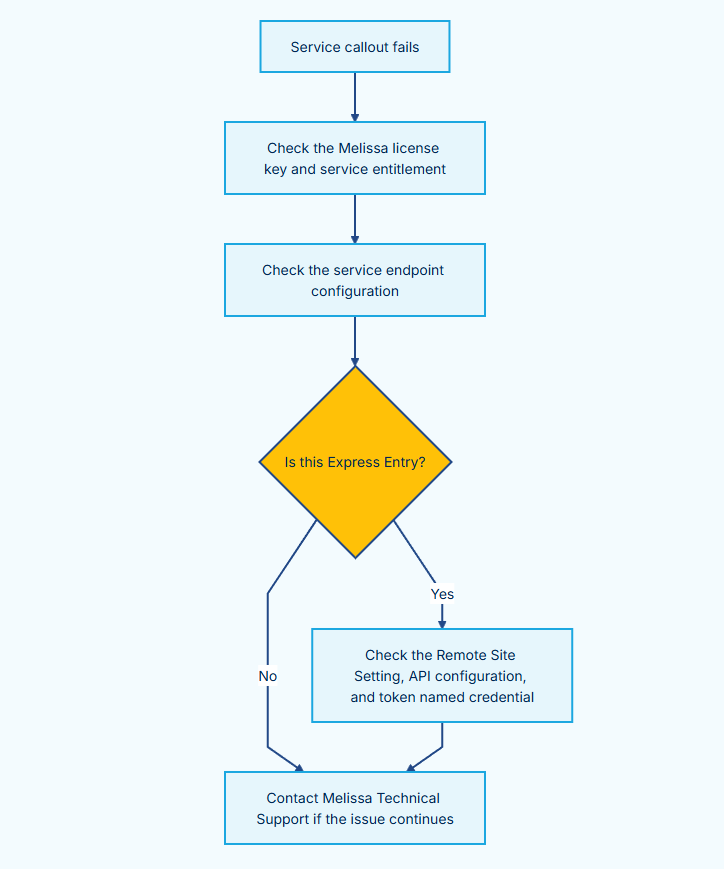
Diagram flow
Service callout fails → Check the Melissa license key and service entitlement
Check the Melissa license key and service entitlement → Check the service endpoint configuration
Check the service endpoint configuration → Is this Express Entry?
Is this Express Entry? → Check the Remote Site Setting, API configuration, and token named credential (Yes)
Is this Express Entry? → Contact Melissa Technical Support if the issue continues (No)
Check the Remote Site Setting, API configuration, and token named credential → Contact Melissa Technical Support if the issue continues
How do mappings work?#
A batch-service mapping defines the Salesforce input fields and the Salesforce output fields. The package stores batch mappings in MD_customMappings__c. Its mapping fields include objectType__c, inputMap__c, and outputMap__c.
Use correct Salesforce field API names in each map. The process reads the input fields and writes results to the mapped output fields. Before a batch run, confirm that the user can read the input fields and edit the output fields.
Express Entry uses reusable MD_expressEntryMap__c records for object-specific address field mappings. Check the target object and field API names when the component does not populate fields.
Where can I review processing logs?#
Use the Clean Suite Log tab to review batch history, processed-record counts, failures, and API call counts. The tab also shows errors and service usage statistics. Use Setup > Async Apex Jobs to monitor an active batch job.
The package also includes the MD_Clean_Suite_Log__c object. An administrator can enable debug logging in Clean Suite administration when more diagnostic data is required.
Where do I get support?#
Contact Melissa Technical Support at Tech@Melissa.com or 800-MELISSA, extension 4. Product documentation is available at docs.melissa.com/software/clean-suite-crm-salesforce/.
Update Procedure from Versions Earlier Than 2.185#
Why does Salesforce block the upgrade?#
An upgrade from a version earlier than 2.185 can fail. Salesforce blocks the package upgrade when the new version removes Apex code that a Visualforce page or a global Visualforce component still needs.

The error lists the Visualforce pages that depend on the removed Apex code.
Install the Melissa patch package first. The patch prepares the org for the new version. Then install the current version from AppExchange. Contact your Salesforce administrator or your Melissa sales engineer for the patch links.
Should I update in production first?#
No. Install and test the update in a sandbox first. Confirm that package objects, permissions, field mappings, and record pages work before you update production.
What must I back up?#
Export Custom Mapping records, Admin Panel settings, and any data t hat stores service output. Record which page layouts, flows, Visualforce overrides, and permission sets use Clean Suite.
Do Custom Mappings require review?#
Yes. Review every mapping after the upgrade. Confirm that every source field and output field exists and that users can edit the output fields.
Update Flow#
This flow shows how to prepare an update and verify the result.

Diagram flow
Export mappings, settings, and service output data → Install and test the update in a sandbox
Install and test the update in a sandbox → Review mappings, permissions, and record pages
Review mappings, permissions, and record pages → Test enabled services and a small batch job
Test enabled services and a small batch job → Review Clean Suite Log and Async Apex Jobs
Review Clean Suite Log and Async Apex Jobs → Update production
What should I check after the update?#
Confirm the Melissa license key remains active.
Confirm Remote Site Settings and Named Credentials remain active.
Reassign or verify Clean Suite permission sets.
Test one record with each enabled service.
Run one small batch job in the sandbox.
Review Clean Suite Log and Async Apex Jobs for errors.
Can I remove old custom fields immediately?#
No. First confirm that no mapping, Flow, report, formula, integration, or page layout uses the field. Preserve source and result data that your retention policy requires.
Why do result fields have different names?#
Package versions can use different field naming conventions. The deployed package user guide identifies Clean_Suite_*__c fields for current package output. Source code can reference MDPERSONATOR__* fields. Inspect your installed package schema before you update mappings.
Clean Suite Batch Processing#
Which services support batch processing?#
The package controller supports Personator, Global Address, Global Email, Global Phone, SmartMover US, and SmartMover Canada batch engines.
Global Express Entry does not support batch processing. It provides interactive address autocomplete. Use Global Address batch processing for existing address records.
Where do I monitor a batch?#
Use Setup → Async Apex Jobs for Salesforce job status. Use the Clean Suite Log tab for service request history, errors, and usage details.
SmartMover also creates SmartMover job and result records.
Why did a batch not update records?#
Check the selected Custom Mapping, target field API names, record update option, and field-level security. Also check the Clean Suite Log for callout and license errors.
Batch Diagnosis Path#
Use this path when a batch does not update records.
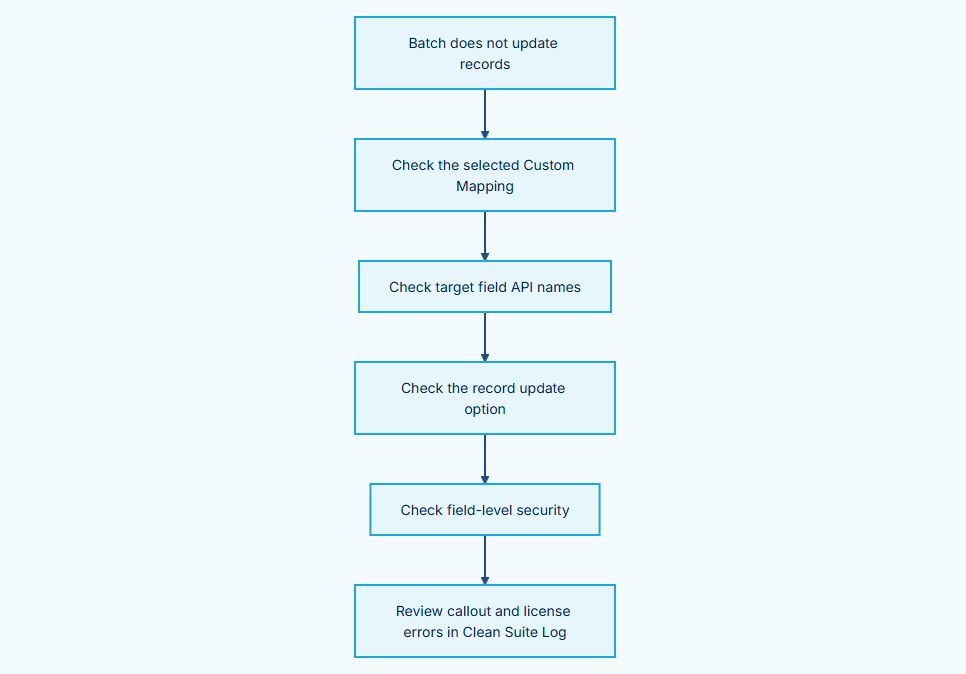
Diagram flow
Batch does not update records → Check the selected Custom Mapping
Check the selected Custom Mapping → Check target field API names
Check target field API names → Check the record update option
Check the record update option → Check field-level security
Check field-level security → Review callout and license errors in Clean Suite Log
Why did a SmartMover batch return no move data?#
For U.S. NCOA processing, the batch needs at least 100 unique names and addresses. A smaller batch can receive address standardization but not NCOA move data.
Can I run two jobs against the same records?#
Avoid it. Concurrent jobs can use credits twice and can create record locks or conflicting output updates.
How do I limit a batch?#
Use a custom SOQL query or the batch interface filter. Select only records that have the inputs required by the service and that need processing.
Can I schedule a batch?#
Yes. A Salesforce administrator can schedule Apex work. Test the selected query, mapping, permissions, and credit use in a sandbox before you enable a recurring job.
Clean Suite Advanced Mappings#
What is an Advanced Mapping?#
An Advanced Mapping tells Clean Suite which Salesforce fields provide service inputs and which fields receive service outputs. The package stores mapping configuration in Custom Mapping records.
Why does a mapping fail?#
A mapping can fail because a required input field is missing or its API name is wrong. It can also fail when the target object is unavailable or field-level security blocks an output update.
Mapping Diagnosis Path#
Use this path to identify a mapping failure.
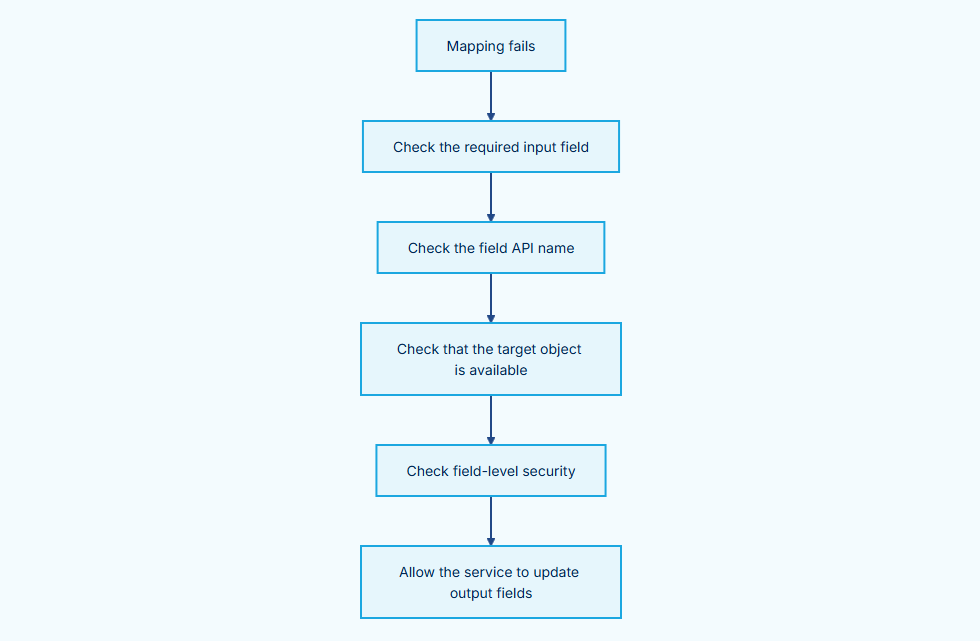
Diagram Flow
Mapping fails → Check the required input field
Check the required input field → Check the field API name
Check the field API name → Check that the target object is available
Check that the target object is available → Check field-level security
Check field-level security → Allow the service to update output fields
Can I map custom objects?#
Yes. The user guide states that batch services can process custom objects. Confirm the object has the required input fields and that the running user can access those fields.
Should I overwrite source fields?#
Use separate output fields when you need an audit trail or user review. Overwrite a source field only when your business rule allows the verified service output to replace it.
How do I test a mapping?#
Create or copy a mapping in a sandbox.
Add one record with known input values.
Run the applicable single-record service or a small batch.
Check mapped output fields and result codes.
Review Clean Suite Log entries.
Why are outputs not visible?#
Check field-level security, page layouts, permission sets, and the mapping field API names. Users need read access to see outputs and edit access when the service writes output fields in user mode.